
When severe weather arrives, the electricity goes out, cell service becomes unreliable, or internet access disappears, a dependable radio can become one of the most useful pieces of emergency equipment you own.
A good emergency radio does much more than receive AM and FM stations. Today’s better models can receive NOAA Weather Radio, provide weather alerts, operate from rechargeable batteries, solar panels or hand cranks, illuminate a dark room, and sometimes provide enough backup power to charge a phone.
But choosing the right model can be confusing.
There are hundreds of inexpensive emergency radios available online, and many look almost identical. Battery capacity, charging methods, NOAA reception, alert functionality, durability and actual usability can vary considerably.
That’s why this guide uses a Consumer Reports-style evaluation approach rather than claiming an official Consumer Reports ranking or endorsement.
We evaluated the most important factors for emergency preparedness, including power flexibility, NOAA compatibility, reception, charging options, lighting, portability, emergency features, customer feedback, brand reputation and overall value.
Top 10 Best Emergency Radio Consumer Reports
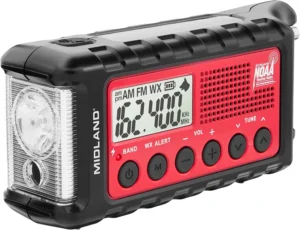
1. Midland ER310 Emergency Crank Weather Radio – Best Overall Emergency Radio
The Midland ER310 is our top overall pick for people who want one versatile emergency radio for home preparedness, camping, hiking, RV travel and power outages.
Its biggest advantage is power flexibility.
The ER310 combines a rechargeable battery, solar charging, hand-crank charging and backup AA batteries. That makes it particularly attractive for situations where the electrical grid is unavailable.
It also includes NOAA Weather Scan and Alert, AM/FM reception, an emergency flashlight and a USB output for external devices.
The flashlight includes an SOS signaling function, while the radio also includes an ultrasonic dog whistle designed for emergency signaling.
Key Features
- NOAA Weather Scan + Alert
- AM/FM radio
- Solar charging
- Hand-crank charging
- Rechargeable 2,600mAh battery
- Backup AA battery capability
- USB phone charging
- 130-lumen CREE LED flashlight
- SOS flashing beacon
- Ultrasonic dog whistle
- Portable design
- Approximately 8 x 2.4 x 3.4 inches
Pros
- Excellent combination of emergency features
- Multiple power options
- Strong NOAA functionality
- Replaceable rechargeable battery
- Useful flashlight
- USB device charging
- Well-established brand
Cons
- Solar charging is relatively slow
- More expensive than basic emergency radios
- Phone charging should be viewed as emergency backup rather than a full power bank
Best For
Home emergency kits, families, campers, RV owners, hikers and serious preparedness enthusiasts.
Why We Recommend It
The ER310 strikes an excellent balance between emergency functionality and portability. It doesn’t try to replace a power station, flashlight or dedicated weather radio, but it combines several important tools into one compact unit.

2. Midland ER210 Emergency Compact Radio – Best Compact Emergency Radio
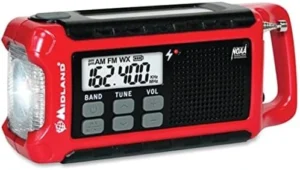
If you want something smaller and easier to carry than the ER310, the Midland ER210 deserves serious consideration.
The ER210 focuses on the essentials: AM/FM radio, NOAA Weather Scan and Alert, rechargeable power, hand-crank capability and an emergency flashlight.
Its compact design makes it especially useful for bug-out bags, vehicle emergency kits, hiking packs and smaller household emergency kits.
Key Features
- NOAA Weather Scan + Alert
- AM/FM reception
- Rechargeable battery
- Hand-crank charging
- USB charging
- Emergency flashlight
- SOS beacon
- Compact design
- Digital tuning
- Approximately 2.8 x 6.5 x 1.9 inches
Pros
- Compact
- Easy to carry
- Strong weather-alert functionality
- Bright emergency light
- Well-known brand
- Large customer-review history
Cons
- No large power bank
- Phone charging is not its strongest feature
- Less versatile than ER310
Best For
Hikers, campers, travelers and anyone building a compact emergency kit.
Why We Recommend It
The ER210 is a good example of why bigger isn’t always better. If you primarily want weather alerts, basic radio reception and emergency lighting without carrying a large device, this is a sensible choice.
3. FosPower A1 2,000mAh Emergency Solar Hand Crank Radio – Best Budget Emergency Radio
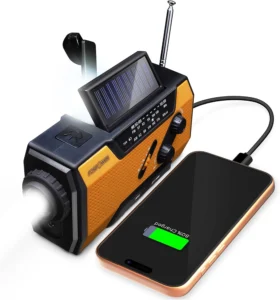
The FosPower A1 is one of the most attractive budget choices for consumers who want multiple charging methods.
The A1 combines solar charging, hand-crank charging, rechargeable battery power and AAA battery backup.
It also provides NOAA, AM and FM reception, a flashlight, reading lights, SOS alarm and USB power-bank functionality.
Key Features
- NOAA Weather Radio
- AM/FM
- Solar charging
- Hand crank
- USB charging
- 2,000mAh rechargeable battery
- AAA battery backup
- USB power bank
- LED flashlight
- Reading light
- SOS alarm
- IPX3 water resistance
- Approximately 6.2 x 2.9 x 2.1 inches
Pros
- Affordable
- Multiple power options
- Lightweight
- Built-in flashlight
- Reading light
- Phone charging capability
- AAA backup
Cons
- Smaller battery than premium models
- Solar charging is slow
- Not designed for heavy-duty phone charging
Best For
Budget-conscious families, campers and first-time emergency-kit buyers.
Why We Recommend It
For the money, the A1 provides an unusually broad feature set. The ability to use solar, crank, rechargeable and AAA power makes it particularly practical during outages.
4. FosPower A3 4,000mAh Emergency Solar Hand Crank Radio – Best for Longer Runtime
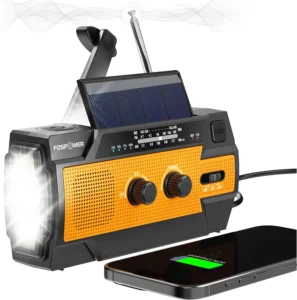
The FosPower A3 is a logical step up from the A1 if you want a larger battery.
Its 4,000mAh power bank gives you more stored energy for the radio and USB devices.
The A3 includes NOAA, AM/FM reception, solar and hand-crank charging, USB charging, flashlight, reading light and SOS functionality.
Key Features
- 4,000mAh rechargeable battery
- NOAA weather channels
- AM/FM
- Solar charging
- Hand crank
- USB charging
- USB output
- 135-lumen flashlight
- Reading lamp
- SOS alarm
- IPX3 water resistance
- Approximately 6.23 x 2.48 x 3.19 inches
Pros
- Larger battery than A1
- Multiple charging options
- Good lighting package
- USB power bank
- Useful for outdoor activities
Cons
- Larger than compact radios
- Solar charging remains slow
- Not a substitute for a dedicated power station
Best For
Families wanting more battery capacity without moving into premium pricing.
Why We Recommend It
The A3 is particularly appealing if phone charging is important to you. Its larger battery gives it an advantage over many inexpensive emergency radios.
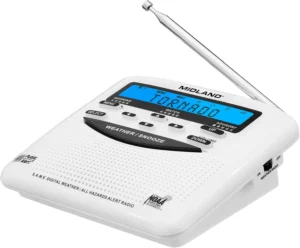
5. Midland WR120B NOAA Emergency Weather Alert Radio – Best Home NOAA Weather Radio
The Midland WR120B is different from the portable radios above.
It is primarily designed to stay in one location and provide weather and emergency alerts.
This makes it particularly useful for a bedroom, kitchen, home office, RV or emergency command area.
The major advantage is its SAME technology, which allows users to configure alerts for specific geographic areas.
Key Features
- NOAA Weather Radio
- SAME alert technology
- 60+ emergency alerts
- AM/FM-style weather-alert receiver
- Trilingual display
- Alarm clock
- Selectable alert tones
- Multiple county programming
- AC-powered design with battery backup
Pros
- Excellent for home alerting
- SAME programming
- Clear display
- Designed specifically around alerts
- Trusted weather-radio brand
Cons
- Not designed as a hiking radio
- No solar charging
- No hand crank
- No large power bank
- Needs household placement
Best For
Homeowners, families and people who prioritize reliable localized weather alerts.
Why We Recommend It
If your priority is receiving weather alerts at home rather than carrying a survival radio into the wilderness, the WR120B may actually be a better choice than a multifunction crank radio.
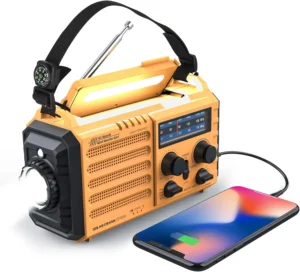
6. Raynic 5000 Emergency Radio – Best Feature-Rich Value
The Raynic 5000-style emergency radios have become popular because they combine many features in a relatively affordable package.
The 5,000mAh-class battery gives this type of radio substantially more stored power than basic models.
It typically combines AM/FM/NOAA reception with solar charging, hand-crank charging, USB charging, flashlight, reading light and SOS functions.
Key Features
- AM/FM
- NOAA weather
- 5,000mAh-class rechargeable battery
- Solar charging
- Hand crank
- USB charging
- USB phone charging
- LED flashlight
- Reading lamp
- SOS alarm
- Water-resistant design on applicable versions
- Portable construction
Pros
- Large battery
- Many emergency functions
- Good value
- Useful lighting
- Phone charging
- Multiple charging methods
Cons
- Model variations can be confusing
- Reception can depend heavily on location
- Larger than minimalist radios
- Solar charging isn’t fast
Best For
Preparedness enthusiasts who want maximum functionality for a moderate budget.
Why We Recommend It
The Raynic 5000 is attractive for people who prefer a feature-heavy emergency radio instead of buying multiple individual devices.
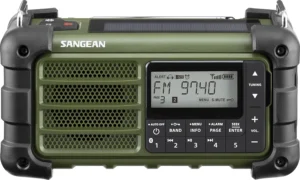
7. Sangean MMR-99 Emergency Radio – Best Premium Emergency Radio
Sangean has a long-standing reputation in portable radio equipment, and the MMR-99 takes a more refined approach to emergency radio design.
It combines emergency functionality with AM/FM/weather reception and multiple power options.
The MMR-99 is particularly interesting for consumers who care about build quality, audio performance and usability rather than simply choosing the cheapest emergency radio available.
Key Features
- AM/FM reception
- Weather band
- Rechargeable battery
- Solar charging
- Hand-crank charging
- USB charging
- Flashlight
- Emergency lighting
- USB device charging
- Portable construction
- Digital tuning
- Approximately 4.5 x 3.5 x 8 inches
Pros
- Premium construction
- Good radio heritage
- Multiple power methods
- Emergency lighting
- Rechargeable design
- Useful for home and outdoor use
Cons
- Higher price
- Heavier than basic emergency radios
- Not the best choice if you only want a simple NOAA receiver
Best For
Buyers willing to spend more for a premium emergency-radio design.
Why We Recommend It
The MMR-99 is a strong option for consumers who want an emergency radio that can also function as a quality everyday portable radio.
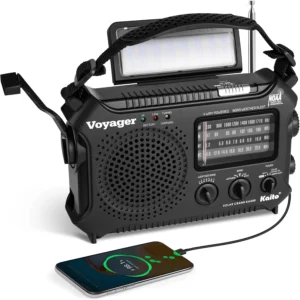
8. Kaito KA500 Voyager Emergency Radio – Best Shortwave Emergency Radio
The Kaito KA500 is particularly interesting for preparedness enthusiasts because it goes beyond standard AM/FM and NOAA reception.
It also includes shortwave bands.
That gives users access to a wider range of broadcasts, which can be useful for people who specifically want broader radio-reception capability.
Key Features
- AM/FM
- Shortwave SW1 and SW2
- Seven NOAA weather channels
- NOAA alert function
- Solar panel
- Hand crank
- AC/DC capability
- Rechargeable Ni-MH battery
- Three AA battery option
- USB output
- LED flashlight
- 5-LED reading lamp
- Water-resistant housing
- Replaceable rechargeable battery
- Approximately 8 x 5 x 2.5 inches
Pros
- Shortwave reception
- Seven NOAA channels
- Five-way power design
- Replaceable rechargeable battery
- Solar panel
- Hand crank
- USB charging
- Reading lamp
Cons
- Larger and heavier
- More complicated than basic radios
- Small internal battery compared with newer high-capacity models
- Not the best choice if you only need NOAA alerts
Best For
Preppers, travelers, radio enthusiasts and people interested in shortwave reception.
Why We Recommend It
The KA500 remains one of the more interesting choices for consumers who want an emergency radio with traditional shortwave capability.
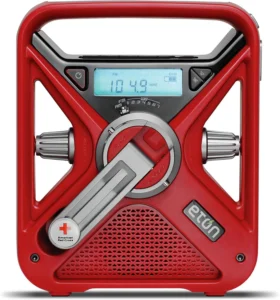
9. Eton American Red Cross FRX3+ – Best for Outdoor Preparedness
The Eton American Red Cross FRX3+ is another established emergency-radio design with a useful combination of weather reception, charging flexibility and emergency lighting.
It includes a 2,600mAh battery, solar charging, hand-crank generation and USB smartphone charging.
Key Features
- AM/FM/weather reception
- 2,600mAh rechargeable battery
- Solar panel
- Hand crank
- USB charging
- USB smartphone charging
- LED flashlight
- Red emergency beacon
- SOS functionality
- Glow-in-the-dark locator
- Backlit display
- AUX input
- Headphone output
- Alarm clock
- Approximately 6.9 x 5.8 x 2.6 inches
Pros
- Recognizable emergency-preparedness brand
- Good power flexibility
- Smartphone charging
- Useful lighting
- Portable
- Outdoor-friendly design
Cons
- Older platform
- Micro-USB rather than USB-C
- Not as large a battery as newer premium radios
- Some newer models offer more features
Best For
Campers, outdoor enthusiasts and consumers who prefer Eton’s emergency-radio lineup.
Why We Recommend It
The FRX3+ remains a sensible choice when you want a proven emergency-radio format with solar, crank and rechargeable power.
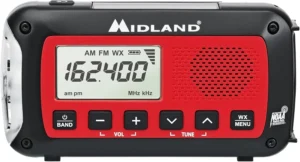
10. Midland ER10VP Weather Radio – Best Lightweight Emergency Radio
The Midland ER10VP is aimed at people who don’t necessarily need a large multifunction survival radio.
It is compact, lightweight and battery-powered, making it convenient for hiking packs, fishing gear, vehicle kits and small emergency bags.
Key Features
- NOAA weather alerts
- AM/FM
- 3 AA batteries
- Built-in flashlight
- SOS strobe
- Headphone jack
- Compact design
- Wrist lanyard
- Portable construction
Pros
- Lightweight
- Simple
- Easy to carry
- Uses common AA batteries
- NOAA alert capability
- Built-in flashlight
Cons
- No solar charging
- No hand crank
- No large rechargeable battery
- No phone charging
- Fewer features than full-size emergency radios
Best For
Hikers, campers, travelers and minimalist emergency kits.
Why We Recommend It
Not everyone needs a 5,000mAh survival radio with a solar panel and reading lamp. If your priority is a small NOAA-capable emergency radio that uses ordinary batteries, the ER10VP makes sense.
Why Every Household Should Own an Emergency Radio
Emergency radios are particularly useful during situations where normal communication infrastructure becomes unreliable.
A major storm can knock out electricity for hours or days. Hurricanes can damage communication infrastructure.
Tornadoes can arrive with little warning. Flooding can make roads inaccessible. Wildfires can force evacuations and disrupt cellular networks.
A radio with independent power sources gives you another way to receive information.
FEMA’s emergency-supply guidance specifically recommends a battery-powered or hand-crank radio capable of receiving NOAA Weather Radio alerts, along with extra batteries.
For households, an emergency radio can provide:
- Severe weather information
- Tornado and flood warnings
- Hurricane updates
- Wildfire information
- Local AM/FM news
- Emergency announcements
- Backup lighting
- USB phone charging on some models
- Information during extended power outages
For campers, hikers and RV owners, a compact emergency radio can also serve as a flashlight, weather receiver and backup power source.
Why NOAA Weather Radio Matters
For U.S. users, NOAA Weather Radio compatibility should be near the top of your checklist.
NOAA Weather Radio All Hazards broadcasts official National Weather Service warnings, watches, forecasts and other emergency information continuously.
The network operates across the United States and uses seven primary weather frequencies from 162.400 to 162.550 MHz.
Some emergency radios simply receive the NOAA weather band.
Others provide more advanced alert functions that can automatically activate the radio or alarm when an emergency warning is transmitted.
This distinction matters.
A radio that receives NOAA broadcasts is useful.
A radio with an actual weather-alert function can be significantly more useful when you are sleeping, working or away from the radio.
For even more precise alerting, look for SAME — Specific Area Message Encoding. SAME-enabled radios can be programmed for specific counties or areas instead of simply reacting to every alert within a broad transmitter coverage area.
How We Selected These Emergency Radios
Our consumer-style evaluation focuses on features that actually matter when electricity and communications are disrupted.
1. NOAA Reception
A good emergency radio for U.S. consumers should receive NOAA Weather Radio whenever possible. NOAA broadcasts official warnings, watches and forecasts 24 hours a day.
2. Alert Capability
Receiving a weather broadcast is different from receiving an automatic alert. Radios with dedicated alert functionality receive additional consideration.
3. Power Flexibility
We favor radios that can continue operating when the grid is unavailable.
Useful options include:
- Rechargeable battery
- Hand crank
- Solar
- AA/AAA batteries
- USB
- AC power
4. Battery Life
A larger battery can be useful during extended outages, particularly if the radio includes USB charging. However, advertised battery capacity shouldn’t be the only deciding factor.
A 10,000mAh power bank doesn’t necessarily mean you can recharge a smartphone multiple times under real emergency conditions.
5. Reception
Radio reception varies based on antenna design, location, terrain, buildings and interference. We therefore avoid claiming that one model will provide perfect reception everywhere.
6. Durability
Emergency equipment may be stored in vehicles, backpacks, garages and emergency kits. Water resistance, robust construction and protected controls are valuable.
7. Customer Feedback
Large numbers of customer reviews can help identify recurring strengths and weaknesses.
However, ratings should be considered alongside specifications rather than treated as absolute proof of performance.
8. Overall Value
The best emergency radio isn’t necessarily the cheapest or most expensive. It is the model that gives you the features you actually need at a reasonable price.
Best Emergency Radio Buying Guide
NOAA Weather Alerts
For U.S. households, NOAA compatibility should be a priority.
NOAA Weather Radio broadcasts on seven primary VHF frequencies:
- 162.400 MHz
- 162.425 MHz
- 162.450 MHz
- 162.475 MHz
- 162.500 MHz
- 162.525 MHz
- 162.550 MHz
If you live in an area with challenging terrain, check NOAA coverage for your location before relying on a radio.
Hand Crank vs. Solar
Hand cranks provide immediate manual power. Solar charging requires sunlight and is therefore slower and weather-dependent.
Ideally, choose a radio that provides both. That way you can recharge the device with sunlight when conditions are favorable and use the crank when immediate power is required.
Rechargeable Batteries
Rechargeable batteries are convenient because you can fully charge the radio before a storm. They are especially useful for frequently used radios.
Replaceable Batteries
Replaceable AA or AAA batteries provide an additional layer of redundancy. Keep a sealed package of spare batteries in the emergency kit.
USB Charging
USB charging is convenient for everyday use. USB-C is preferable on newer radios because the cable is increasingly common.
Older micro-USB models can still be perfectly functional, but you should keep the correct cable with the radio.
Phone Charging
Emergency radios with USB output can sometimes charge phones. However, don’t assume the radio is a replacement for a power bank.
A small 2,000mAh emergency radio may only provide limited smartphone charging after accounting for conversion losses and the power required to operate the radio itself.
Battery Capacity
Higher capacity is useful, but don’t judge a radio solely by its mAh number.
Consider:
- Radio runtime
- Flashlight runtime
- USB output
- Charging efficiency
- Battery type
- Ability to use backup batteries
Flashlight Brightness
A built-in flashlight is extremely useful during power outages.
Look for:
- High and low modes
- SOS/strobe mode
- Separate reading light
- Directional beam
But keep a dedicated flashlight in your emergency kit too.
Water Resistance
A water-resistant radio is helpful during:
- Rainstorms
- Camping
- Hiking
- Flood preparation
- RV travel
Remember that water resistance is not necessarily the same as waterproofing.
Portability
For home use, size is less important. For hiking or bug-out bags, weight matters significantly. A compact radio may be preferable even if it has fewer features.
Hand Crank vs. Solar vs. Battery-Powered Radios
| Factor | Hand Crank | Solar | Battery Powered |
| Power reliability | Excellent | Good | Excellent with spares |
| Maintenance | Low | Low | Requires replacement batteries |
| Charging speed | Slow/moderate | Slow | Fast replacement |
| Portability | Excellent | Excellent | Excellent |
| Cost | Moderate | Moderate | Usually low |
| Emergency readiness | Excellent | Excellent when sunny | Excellent |
| Best Users | Preppers | Campers/outdoors | Homeowners/travelers |
Which Should You Choose?
- For maximum redundancy, choose a multi-power radio with solar, crank and battery capability.
- For a home bedroom, a dedicated NOAA alert radio with AC and battery backup can be better.
- For hiking, prioritize low weight.
- For RV use, consider a radio with multiple charging options and USB output.
Essential Emergency Radio Features
NOAA Weather Radio
This is one of the most important features for U.S. preparedness.
AM/FM Reception
AM and FM remain useful for local news, emergency information and community broadcasts.
Shortwave
Shortwave isn’t essential for every household, but it can appeal to radio enthusiasts and preparedness-minded users who want access to additional broadcasts.
SOS Siren
An SOS alarm can help attract attention, particularly outdoors. It should be considered a signaling backup, not a guaranteed rescue system.
LED Flashlight
A flashlight can be extremely useful during a power outage.
Also Read: Top 10 Best Fire Blankets Consumer Reports & Reviews With Buyer’s Guide
Reading Lamp
A reading lamp can illuminate a room or tent without requiring a separate lantern.
Power Bank
A USB output can provide emergency power for a phone or other small device. Remember that the amount of usable power may be limited.
USB-C Charging
USB-C is increasingly convenient because many phones, power banks and other electronics already use the same connector.
Water Resistance
Useful for outdoor emergencies and wet-weather conditions.
Emergency Preparedness Tips
Owning the best emergency radio is only one part of being prepared.
Keep the Radio Charged
Don’t wait until a hurricane or severe storm warning to charge it. Maintain the rechargeable battery and periodically inspect the device.
Test It Regularly
Turn on the radio every few months.
Confirm that:
- The battery still holds a charge
- The flashlight works
- The crank mechanism operates
- NOAA reception works
- The charging cable works
- Spare batteries are still fresh
Store It in an Emergency Kit
Keep the radio somewhere easy to locate.
Good locations include:
- Emergency supply closet
- Bedroom
- Basement
- Garage
- RV emergency compartment
- Bug-out bag
Keep Backup Batteries
Even if your radio has solar and crank charging, spare batteries provide useful redundancy.
Know Your Local NOAA Station
Before an emergency, identify the strongest NOAA frequency serving your area. This eliminates unnecessary searching when severe weather develops.
Keep Charging Cables Together
If your radio uses USB-C or micro-USB, store its cable directly beside the radio.
Don’t Rely on One Device
Your preparedness kit should also contain:
- Drinking water
- Non-perishable food
- Flashlights
- Spare batteries
- First aid supplies
- Phone power bank
- Whistle
- Basic tools
- Important documents
- Necessary medications
- Local maps
An emergency radio is an information tool, not a complete survival system.
Frequently Asked Questions about Best Emergency Radio Consumer Reports
Q. What is the best emergency radio overall?
Ans. The Midland ER310 is our best overall choice because it combines NOAA weather alerts, AM/FM reception, solar charging, hand-crank charging, rechargeable and backup battery options, emergency lighting and USB device charging.
Q. Do emergency radios work without electricity?
Ans. Yes. Radios equipped with rechargeable batteries, hand cranks, solar panels or replaceable batteries can continue operating when household electricity is unavailable.
Q. Are hand crank radios reliable?
Ans. A quality hand-crank radio can be very useful during an outage because it doesn’t depend on the electrical grid.
However, cranking is best viewed as an emergency power method rather than a convenient replacement for normal charging.
Q. Is a NOAA weather radio worth buying?
Ans. Yes, particularly for U.S. households located in areas vulnerable to severe weather. NOAA Weather Radio provides official National Weather Service information and emergency warnings.
Q. Can emergency radios charge smartphones?
Ans. Some can. Look for a USB output or power-bank function. However, emergency-radio batteries are generally much smaller than dedicated power banks, so phone charging should be considered a backup feature.
Q. How long do rechargeable emergency radios last?
Ans. Runtime varies significantly by model, battery capacity, volume level, flashlight usage and charging condition.
Larger batteries generally provide longer runtime, but manufacturers’ runtime figures should be treated as estimates.
Q. Should I choose solar or hand crank?
Ans. If possible, choose both. Solar charging is convenient when sunlight is available, while hand-crank charging provides a power source during cloudy conditions or nighttime emergencies.
Q. Can emergency radios receive local stations?
Ans. Yes. Most AM/FM emergency radios can receive local broadcast stations, although reception depends on antenna design, signal strength, terrain, buildings and interference.
Q. How often should I test my emergency radio?
Ans. A practical approach is to test it every few months and before severe-weather seasons. Check the radio, flashlight, battery, charging cable and NOAA reception.
Q. Which emergency radio offers the best value?
Ans. The FosPower A1 is one of the strongest budget-value options because it combines NOAA, AM/FM, solar, crank, rechargeable and AAA power with lighting and USB charging.
Q. Is a more expensive emergency radio always better?
Ans. No. A premium radio may offer better construction or additional features, but a simple NOAA radio may be more appropriate for someone who only wants reliable weather alerts at home.
Q. Do emergency radios replace smartphones?
Ans. No. Emergency radios and smartphones serve different purposes. A smartphone provides two-way communication, apps and internet access when networks are available.
An emergency radio provides independent access to broadcast information when cellular or internet services become unavailable.
Final Verdict on Best Emergency Radio Consumer Reports
Choosing the best emergency radio Consumer Reports-style doesn’t mean finding one device that has every possible feature.
The better approach is to identify what you need the radio to do.
🏆 Best Overall: Midland ER310
The Midland ER310 is our top choice for most households because it combines NOAA weather alerts, AM/FM, solar charging, hand-crank charging, rechargeable power, backup batteries, emergency lighting and USB charging.
💰 Best Budget Pick: FosPower A1
The FosPower A1 delivers a lot of emergency functionality at a relatively affordable price. It’s an excellent first emergency radio.
⭐ Best Premium Pick: Sangean MMR-99
The Sangean MMR-99 is a compelling choice for consumers who value premium construction and a more refined portable-radio experience.
🌞 Best Solar Emergency Radio: FosPower A3
The FosPower A3 stands out for combining solar and hand-crank charging with a larger 4,000mAh battery.
🔋 Best Hand Crank Radio: Midland ER210
The ER210 is compact, practical and easy to carry, making it a strong option for emergency kits and outdoor activities.
🏕 Best for Camping: Kaito KA500
The Kaito KA500 is particularly attractive for campers, travelers and radio enthusiasts because it adds shortwave reception to AM/FM and NOAA.
🏠 Best for Home Emergency Kits: Midland WR120B
For a stationary home weather-alert system, the WR120B is a better fit than many multifunction survival radios because its focus is localized emergency alerting.
Should You Buy an Emergency Radio?
If you live in an area affected by hurricanes, tornadoes, severe thunderstorms, floods, wildfires, winter storms or extended power outages, an emergency radio is a relatively inexpensive addition to your preparedness equipment.
For most people, the Midland ER310 is the easiest recommendation.
If you want something less expensive, consider the FosPower A1.
If localized home alerts are your primary concern, look at the Midland WR120B.
If you want shortwave capability, the Kaito KA500 is worth considering.
And if portability is your biggest priority, the Midland ER210 or ER10VP may make more sense.
Before purchasing, compare the current Amazon price, availability, customer ratings and exact model number.
Amazon listings can change, and different versions of the same product may have different batteries, charging ports or feature sets.
| Rank | Emergency Radio | Best For | NOAA | Crank | Solar | Rechargeable | Phone Charging | Pricing |
| 1 | Midland ER310 | Overall | Yes | Yes | Yes | Yes | Yes | Check Price On Amazon |
| 2 | Midland ER210 | Compact | Yes | Yes | Model-dependent/verify listing | Yes | Limited | Check Price On Amazon |
| 3 | FosPower A1 | Budget | Yes | Yes | Yes | Yes | Yes | Check Price On Amazon |
| 4 | FosPower A3 | Battery capacity | Yes | Yes | Yes | Yes | Yes | Check Price On Amazon |
| 5 | Midland WR120B | Home alerts | Yes | No | No | Battery backup | No | Check Price On Amazon |
| 6 | Raynic 5000 | Features/value | Yes | Yes | Yes | Yes | Yes | Check Price On Amazon |
| 7 | Sangean MMR-99 | Premium | Yes | Yes | Yes | Yes | Yes | Check Price On Amazon |
| 8 | Kaito KA500 | Shortwave | Yes | Yes | Yes | Yes | Yes | Check Price On Amazon |
| 9 | Eton FRX3+ | Outdoor use | Yes | Yes | Yes | Yes | Yes | Check Price On Amazon |
| 10 | Midland ER10VP | Lightweight | Yes | No | No | No | No | Check Price On Amazon |