
Fresh juice is one of the easiest ways to turn fruits and vegetables into a convenient homemade drink. Instead of purchasing bottled juice, a home juicer lets you choose your own ingredients, control the flavor, and make a batch whenever you want.
But choosing the right machine can be surprisingly difficult.
There are centrifugal juicers designed for speed, cold press juicers designed for slower extraction, masticating juicers that excel with leafy greens, and large batch machines designed for families.
That is why we created this top rated juicers consumer reports-style guide using consumer-focused evaluation criteria rather than claiming any official Consumer Reports ranking.
We evaluated factors such as extraction performance, juice quality, ease of cleaning, feed-chute design, noise, versatility, build quality, warranty coverage, customer feedback, and overall value.
Best 9 Top Rated Juicers Consumer Reports
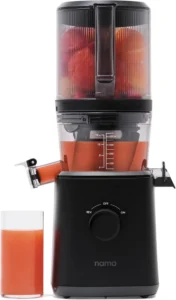
1. Nama J2 Cold Press Juicer — Best Overall
The Nama J2 is one of the most compelling choices for households that plan to juice regularly. Its biggest advantage is convenience: the self-feeding hopper allows users to load a recipe rather than continuously pushing individual pieces of produce into the machine.
The J2 uses a slow cold-press system and operates around 50 RPM. Its 200-watt motor and large hopper make it particularly attractive for batch juicing.
Current Amazon-indexed information identifies the J2 as an Amazon.com product, with the listing showing a 9.8-inch width, 9-inch depth, and approximately 17.7-inch height.
Nama’s documentation also lists 200W power, 50 RPM operation, and a long 15-year warranty on the J2 XL platform.
Key Features
- Cold press/masticating extraction
- Approximately 50 RPM
- 200W motor
- Large self-feeding hopper
- Hands-free operation
- Designed for high juice yield
- Suitable for fruits and vegetables
- Particularly convenient for batch juicing
- Long manufacturer warranty on applicable models
Pros
- Excellent convenience
- Large hopper
- Quiet compared with centrifugal machines
- Strong juice extraction
- Excellent for regular juicers
- Minimal hands-on feeding
Cons
- Expensive
- Large countertop footprint
- Premium pricing may not make sense for occasional users
- Cleaning still requires attention after each batch
Best For
Frequent juicers, families, meal preppers, and people who want hands-free operation.
Why We Recommend It
The Nama J2 combines the qualities most people want from a premium home juicer: excellent extraction, low-speed operation, convenient feeding, and strong overall usability.

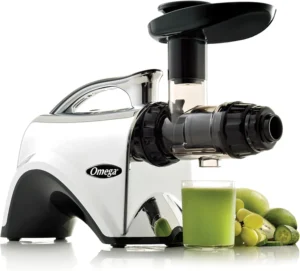
2. Omega NC900HDC — Best for Leafy Greens and Versatility
The Omega NC900HDC is a horizontal masticating juicer designed for people who want more than basic fruit juice.
It operates at approximately 80 RPM and uses a single-auger system. Omega lists a 150-watt motor, automatic pulp ejection, five adjustable pressure settings, and a 15-year limited warranty.
Its horizontal design can be especially useful for leafy greens, fibrous vegetables, wheatgrass, and other ingredients that can challenge inexpensive centrifugal machines.
The NC900HDC also works as more than a juice extractor. Its nutrition-system attachments can be used for foods such as nut butter, pasta, sorbet, and alternative milks.
Key Features
- Masticating cold press design
- 80 RPM
- 150W motor
- Single auger
- Five pressure settings
- Automatic pulp ejection
- Quiet operation
- Top-rack dishwasher-safe removable components
- 15-year limited warranty
Pros
- Excellent versatility
- Strong reputation for durability
- Excellent for leafy greens
- Long warranty
- Quiet compared with centrifugal juicers
- Can perform several food-preparation tasks
Cons
- Heavy
- Takes more counter space horizontally
- Narrower feeding requires more preparation
- Premium price
Best For
Green juice enthusiasts, wheatgrass users, and people who want a multifunctional appliance.
Why We Recommend It
If your priority is leafy greens and versatility rather than maximum speed, the Omega NC900HDC remains a very interesting choice.
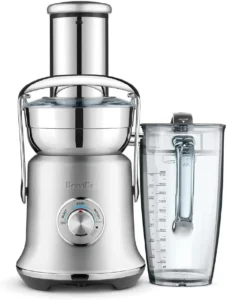
3. Breville Juice Fountain Cold XL — Best Centrifugal Juicer for Families
If speed is your priority, the Breville Juice Fountain Cold XL deserves serious consideration.
This is a centrifugal juicer rather than a traditional masticating machine. Breville gives it a large 3.5-inch feed chute and a 70-ounce juice jug, making it particularly suitable for households that want to process a lot of produce quickly.
Breville says the machine can extract up to 70 ounces and uses Cold Spin Technology to minimize temperature transfer during extraction. It also includes a noise-reduction setting.
The machine measures approximately 13.4 x 8.7 x 17.4 inches.
Key Features
- Centrifugal juice extractor
- 3.5-inch extra-wide feed chute
- 70-ounce juice jug
- Large pulp container
- Cold Spin Technology
- Noise-reduction technology
- Stainless steel cutting disc
- Italian-made mesh filter
- Large batch capacity
Pros
- Very fast
- Excellent for whole fruits and vegetables
- Large capacity
- Great for families
- Minimal preparation
- Strong performance with hard produce
Cons
- Louder than most slow juicers
- Juice may separate faster
- Less ideal for leafy greens
- Large countertop footprint
Best For
Families and busy people who value speed over ultra-slow extraction.
Why We Recommend It
For shoppers who don’t want to wait several minutes for a slow juicer to process a recipe, the Juice Fountain Cold XL is one of the most practical choices.
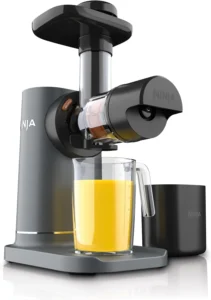
4. Ninja NeverClog Cold Press Juicer — Best Value
The Ninja NeverClog Cold Press Juicer JC151 is one of the easiest premium-brand options to recommend to shoppers who don’t want to spend $500 or more.
Ninja lists a 150-watt motor, 24-ounce juice jug, 36-ounce pulp container, two programs, reverse operation, pulp control, dishwasher-safe components, and a one-year limited warranty.
The reverse function is particularly useful when fibrous ingredients begin to slow the auger.
Key Features
- Cold press/masticating extraction
- 150W motor
- Reverse function
- Two one-touch programs
- Pulp-control filters
- 24-ounce juice jug
- 36-ounce pulp container
- Dishwasher-safe components
- Anti-drip lever
Pros
- Excellent value
- Affordable compared with premium machines
- Reverse function
- Easy setup
- Dishwasher-safe parts
- Good for everyday home use
Cons
- Smaller batch capacity than premium machines
- One-year warranty
- Not as feature-rich as Nama or Kuvings
Best For
First-time juicers and budget-conscious shoppers who want cold-press extraction.
Why We Recommend It
The Ninja NeverClog delivers many of the features shoppers want from a slow juicer without entering premium pricing territory.
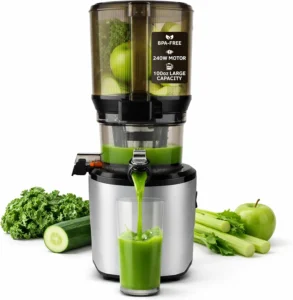
5. Kuvings AUTO10 Hands-Free Slow Juicer — Best Premium Batch Juicer
The Kuvings AUTO10 is designed for serious home juicers who want to prepare large batches with minimal hands-on work.
The AUTO10 is a premium cold-press juicer with a very large hopper and approximately 50 RPM extraction.
Testing coverage has highlighted its ability to handle ingredients such as carrots, celery, kale, ginger, and citrus while producing relatively dry pulp.
Key Features
- Cold press/masticating system
- Approximately 50 RPM
- Large hands-free hopper
- Around 100-ounce hopper capacity
- Powerful motor
- Batch juicing design
- Low-speed extraction
- Suitable for families
Pros
- Huge batch capacity
- Hands-free operation
- Excellent for frequent juicing
- Strong performance with fibrous ingredients
- Premium construction
Cons
- Very expensive
- Large and heavy
- Overkill for occasional juicers
- Cleaning requires more work than some centrifugal machines
Best For
Large households and serious juice enthusiasts.
Why We Recommend It
The AUTO10 is most appealing when convenience and batch capacity matter more than keeping the machine compact or inexpensive.
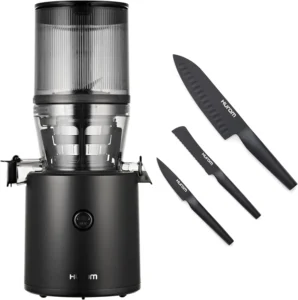
6. Hurom H320 Slow Juicer — Best Premium Family Juicer
Hurom is one of the better-known names in slow juicing, and the H320 is designed around convenient batch preparation.
The H320 has a self-feeding design and large hopper. Independent testing has praised its ability to produce smooth juice with relatively dry pulp.
Key Features
- Slow/masticating extraction
- Self-feeding hopper
- Large batch capacity
- Fine and coarse straining options
- Quiet operation
- Premium construction
- Designed for mixed produce
Pros
- Excellent juice quality
- Convenient self-feeding design
- Premium build
- Good for families
- Quiet operation
Cons
- Expensive
- Large countertop footprint
- Verify Amazon seller before buying
- Not the best option for shoppers who juice only occasionally
Best For
Families and dedicated juicers seeking premium slow extraction.
Why We Recommend It
The H320 is a strong alternative to Nama and Kuvings for shoppers who value premium construction and hands-free batch juicing.
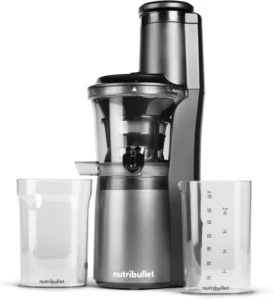
7. NutriBullet Slow Juicer — Best Compact Slow Juicer
The NutriBullet Slow Juicer NBJ50300 is an attractive choice for consumers who want masticating-style extraction without purchasing a huge premium appliance.
The manufacturer documentation specifies a 150-watt motor and includes a 24-ounce juice container and pulp container.
The model also carries a one-year limited warranty.
Key Features
- Slow masticating extraction
- 150W motor
- 24-ounce juice container
- Pulp container
- Steel-tipped auger
- Cleaning brush
- Compact design
- One-year limited warranty
Pros
- Recognizable brand
- More affordable than premium machines
- Good for smaller households
- Suitable for everyday fruit and vegetable juice
- Compact relative to large batch machines
Cons
- Smaller capacity
- Shorter warranty
- Not as versatile as Omega
- More preparation than hands-free models
Best For
Apartments, smaller kitchens, beginners, and occasional juicers.
Why We Recommend It
This is a sensible middle ground for shoppers who want slow juicing without paying premium-machine prices.
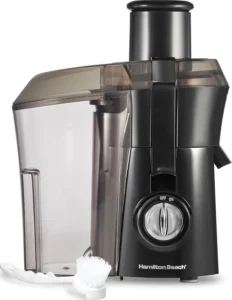
8. Hamilton Beach Big Mouth Juice Extractor — Best Budget Centrifugal Juicer
The Hamilton Beach Big Mouth is a straightforward centrifugal juice extractor built around speed and simplicity.
Depending on the specific Big Mouth model, specifications can vary slightly. The commonly listed 800-watt versions use a 3-inch feed chute and dishwasher-safe removable components. The 67702 version, for example, has an 80-ounce pulp bin and an 800-watt motor.
The Big Mouth Pro is also rated highly by current retail customer feedback, with reviewers frequently mentioning ease of use and cleanup while some note that centrifugal operation can be noisy.
Key Features
- Centrifugal extraction
- 800W motor on common versions
- 3-inch feed chute
- Stainless steel mesh filter
- Large pulp container
- Dishwasher-safe removable parts
- Simple controls
- Three-year warranty on applicable versions
Pros
- Affordable
- Very fast
- Large feed chute
- Easy to operate
- Dishwasher-safe parts
- Good for hard fruits and vegetables
Cons
- Noisy
- More foam and separation than many slow juicers
- Less effective with leafy greens
- Model specifications vary
Best For
Budget shoppers who want fast fruit and vegetable juice.
Why We Recommend It
If you simply want to turn apples, carrots and other firm produce into juice quickly, the Big Mouth offers excellent practicality for the money.
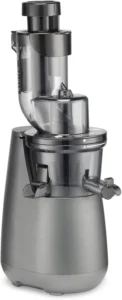
9. Cuisinart Easy Clean Slow Juicer — Best for Easy Cleanup
Cleaning is one of the biggest reasons people stop using their juicer. The Cuisinart Easy Clean Slow Juicer CSJ-300P1 attempts to solve that problem with a mesh-free filter design.
Cuisinart describes it as a masticating slow juicer with a mesh-free filter, top-rack dishwasher-safe removable parts, and a three-year limited warranty.
This makes it particularly interesting for consumers who want slow extraction but don’t want to spend excessive time scrubbing a traditional fine-mesh filter.
Key Features
- Masticating slow juicer
- Mesh-free filter
- Top-rack dishwasher-safe parts
- Quiet operation
- Suitable for fruits and vegetables
- Can process greens and nuts
- 3-year limited warranty
- Approximately 10.24 x 6.97 x 18.27 inches
Pros
- Easy-clean design
- Dishwasher-safe removable parts
- Quiet
- Versatile
- Reasonable premium price
- Three-year warranty
Cons
- Tall design
- Slower than centrifugal juicers
- Not as convenient as self-feeding premium models
Best For
Consumers who prioritize cleanup and everyday convenience.
Why We Recommend It
A juicer that is easy to clean is more likely to be used consistently. Cuisinart’s mesh-free filter makes this model especially attractive for regular home use.
How We Selected These Juicers
Our consumer-style evaluation methodology focuses on practical factors that matter after the purchase—not simply motor wattage or marketing claims.
1. Juice Yield
A good juicer should extract a substantial amount of liquid while leaving relatively dry pulp.
However, yield varies considerably depending on the ingredient. Carrots, apples, celery, citrus, leafy greens and soft fruit behave differently.
Therefore, a single “juice yield” percentage can be misleading.
2. Juice Quality
We considered:
- Pulp level
- Foam
- Separation
- Smoothness
- Consistency
- Performance with different produce
Cold press machines generally have an advantage when consumers want smooth juice with less foam and slower oxidation.
3. Ease of Cleaning
A juicer that takes 20 minutes to clean can quickly become an appliance that sits unused.
We therefore give considerable weight to:
- Dishwasher-safe components
- Filter design
- Number of removable parts
- Ease of disassembly
- Cleaning brushes
- Pulp removal
4. Noise
Centrifugal juicers typically produce more mechanical noise because they operate at high speeds. Slow juicers generally operate more quietly.
5. Build Quality
We considered the reputation of the manufacturer, materials, design, warranty and availability of replacement parts.
6. Features
Useful features include:
- Reverse operation
- Self-feeding hoppers
- Multiple filters
- Pulp control
- Anti-drip systems
- Large juice containers
- Wide feed chutes
7. Customer Feedback
Customer reviews can reveal issues that specifications don’t show, such as:
- Difficult assembly
- Clogging
- Cleanup problems
- Motor durability
- Noise
- Pulp quality
Ratings should be checked on the current Amazon product page because they change over time.
Cold Press vs. Centrifugal Juicer
Understanding this difference is more important than choosing a particular brand.
| Factor | Cold Press/Masticating | Centrifugal |
| Juice Yield | Generally very good | Good to very good |
| Speed | Slow | Very fast |
| Noise | Usually quieter | Usually louder |
| Cleaning | Moderate | Moderate |
| Oxidation | Generally less exposure | Generally more exposure |
| Price | Often higher | Often lower |
| Leafy Greens | Excellent on suitable models | Usually weaker |
| Hard Produce | Very good | Excellent |
| Soft Produce | Good with appropriate model | Model dependent |
| Best For | Regular juice enthusiasts | Speed-focused users |
Cold Press Juicers
A cold press juicer uses an auger to crush and squeeze produce at relatively low speed. This process generally creates less foam and can produce smooth juice with good extraction. The downside is speed.
Centrifugal Juicers
A centrifugal juicer uses a rapidly spinning cutting disc and mesh basket to separate juice from pulp.
Its biggest advantage is speed.
For someone making a quick glass of apple or carrot juice before work, centrifugal technology can be extremely convenient.
Also Read: Consumer Report Best Coffee Maker: Top 10 Coffee Machines for Home & Office
Top Juicer Buying Guide: How to Choose the Best Juicer
Cold Press or Centrifugal?
Choose cold press if:
- You juice leafy greens
- You want quieter operation
- You prioritize extraction quality
- You make juice regularly
- You don’t mind slower processing
Choose centrifugal if:
- Speed matters most
- You mostly juice firm produce
- You want a lower-cost machine
- You don’t mind more noise
Feed Chute Size
A wider chute reduces preparation time.
A 3-inch or larger chute can accept larger pieces of produce, while self-feeding hoppers can reduce manual feeding even further.
Motor Power
Don’t automatically assume more watts means better juicing.
A well-designed 150W slow juicer can perform differently from an 850W centrifugal juicer because the machines use completely different extraction mechanisms.
Look at the entire system rather than wattage alone.
Noise
If you live in an apartment or juice early in the morning, a slow juicer may be more comfortable. Centrifugal machines are generally faster but louder.
Juice Yield
If you’re buying expensive organic produce, extraction efficiency matters.
Look for:
- Dry pulp
- Good performance with fibrous ingredients
- Strong leafy-green performance
- Efficient auger design
Cleaning
Consider cleaning before buying. If a machine requires extensive brushing after every glass, you may use it less frequently.
Dishwasher-safe components and mesh-free filters can make a significant difference.
Reverse Function
A reverse function can help clear fibers when the auger becomes blocked. It is particularly useful for fibrous ingredients such as celery and ginger.
Pulp Control
Some juicers include different filters or pulp-control settings. This is useful if one person prefers very smooth juice while another likes more pulp.
Size and Storage
Measure your countertop before buying. Tall vertical machines may fit beneath cabinets differently from horizontal Omega-style machines.
Warranty
Warranty length varies significantly. Omega and some premium brands offer much longer coverage than budget models. Always confirm the exact warranty for the model and seller you purchase.
Best Fruits and Vegetables for Juicing
Apples
Apples are excellent for both centrifugal and slow juicers. Wash them thoroughly and follow the manufacturer’s guidance regarding seeds, stems and preparation.
Carrots
Carrots are firm and work well in both centrifugal and masticating machines. They are particularly useful for testing a juicer’s ability to handle dense produce.
Celery
Celery contains long fibers that can wrap around some augers. Cutting celery into shorter pieces according to the manufacturer’s instructions can help reduce clogging.
Spinach
Spinach is a leafy green that generally performs better in a masticating juicer than a centrifugal machine.
Kale
Kale can be juiced effectively in many slow juicers. Roll or bunch leafy greens according to the machine’s instructions.
Oranges
Remove the peel and follow the manufacturer’s recommendations before processing citrus. Some machines handle peeled citrus particularly well.
Beets
Beets are dense and hard. A powerful juicer can process them, but cutting them into appropriate pieces can reduce strain on the machine.
Cucumber
Cucumber is relatively easy to juice and can add substantial liquid to mixed vegetable recipes.
Ginger
Ginger is highly fibrous. Use smaller pieces and alternate it with wetter produce if recommended by the manufacturer.
Pineapple
Remove the tough outer skin and follow the manufacturer’s preparation instructions. Depending on the juicer, fibrous pineapple cores may require additional preparation.
Important Preparation Rule
Never assume that a juicer can process an ingredient whole simply because the feed chute is wide.
Large pits, hard seeds, extremely tough peels and inedible parts should be removed according to the manufacturer’s instructions.
Juicer Maintenance Tips
Clean Immediately
The easiest time to clean a juicer is immediately after use. Pulp becomes much harder to remove once it dries.
Remove Pulp
Empty the pulp container promptly. Leaving wet pulp inside can create unpleasant odors and make cleanup harder.
Clean Filters Thoroughly
Centrifugal machines often use fine mesh filters. These should be cleaned carefully because dried pulp can accumulate inside the small openings.
Descale When Appropriate
If your manufacturer recommends descaling or periodic deep cleaning, follow the instructions for your particular model.
Inspect Seals and Augers
Check removable components periodically for:
- Cracks
- Excessive wear
- Damaged seals
- Discoloration
- Unusual movement
Store Properly
Allow components to dry completely before storage. Do not store a juicer wet or with trapped pulp.
Don’t Overload the Machine
Even a powerful juicer can struggle when overloaded. Feed ingredients at the rate recommended by the manufacturer.
Frequently Asked Questions about Top Rated Juicers Consumer Reports
Q. What is the best juicer overall?
Ans. For many households, the Nama J2 is an excellent overall choice because of its hands-free hopper, slow extraction, high convenience and strong performance.
However, the best juicer depends on your budget and preferred ingredients.
Q. Are cold press juicers worth it?
Ans. They can be worth it for people who juice frequently, particularly those who prioritize juice quality, quieter operation and leafy-green performance.
For occasional users who mainly juice apples and carrots, a centrifugal juicer may offer better value.
Q. Which juicer produces the most juice?
Ans. Juice yield depends on the ingredient, preparation technique and machine. High-quality masticating juicers often perform very well with leafy greens and fibrous produce, while centrifugal models can be extremely effective with firm fruits and vegetables.
Q. Are slow juicers healthier?
Ans. A slow juicer does not automatically make juice “healthier.” The nutritional value of your drink depends heavily on the ingredients and overall diet.
Slow extraction may reduce foam and exposure to air compared with high-speed extraction, but fresh juice should still be considered part of a balanced diet rather than a replacement for whole foods or medical treatment.
Q. How often should I clean my juicer?
Ans. Ideally, clean the removable components after every use. Regular immediate cleaning prevents pulp from drying and makes the machine easier to maintain.
Q. Can I juice leafy greens?
Ans. Yes. Masticating juicers are generally better suited to leafy greens such as kale and spinach than many centrifugal machines.
Q. Can I make nut milk with a juicer?
Ans. Some masticating juicers are designed to process nuts or make alternative milks.
The Omega NC900HDC and Cuisinart Easy Clean, for example, offer functionality beyond ordinary fruit and vegetable juice. Always follow the specific manufacturer’s instructions.
Q. How long does fresh juice last?
Ans. Fresh juice is generally best consumed soon after preparation.
If you store it, use a clean airtight container and refrigerate it promptly. Follow food-safety practices and your juicer manufacturer’s recommendations.
Q. Which juicer is easiest to clean?
Ans. There is no single answer because cleaning depends on the design.
The Cuisinart Easy Clean is particularly appealing because of its mesh-free filter and dishwasher-safe removable components. The Ninja NeverClog also offers dishwasher-safe components.
Q. Which juicer offers the best value?
Ans. The Ninja NeverClog is one of the strongest value choices in this guide because it combines slow extraction, reverse operation, pulp control and dishwasher-safe components at a much lower price than premium machines.
Q. Is a centrifugal juicer bad for vegetables?
Ans. No.
Centrifugal juicers can perform very well with many vegetables, especially firm vegetables such as carrots and beets. They are simply less specialized for certain leafy and fibrous ingredients.
Q. Is a 150-watt juicer powerful enough?
Ans. Motor wattage should not be considered by itself.
A slow juicer uses a different extraction mechanism from a centrifugal machine. Torque, auger design and overall engineering also matter.
Final Verdict on Top Rated Juicers Consumer Reports
There isn’t one perfect machine for every household.
Your ideal juicer depends on how often you juice, which ingredients you use, how much countertop space you have and how much you’re willing to spend.
🏆 Best Overall: Nama J2
The Nama J2 is our leading all-around recommendation for frequent home juicers. Its hands-free hopper and slow extraction make it particularly convenient for families and batch preparation.
💰 Best Budget Pick: Ninja NeverClog
The Ninja NeverClog offers an appealing combination of cold-press extraction, reverse operation, pulp control and easy cleanup without the premium price of high-end machines.
⭐ Best Premium Pick: Kuvings AUTO10
For serious juicers who want a very large hopper and hands-free batch operation, the Kuvings AUTO10 is a premium option worth considering.
🥬 Best Cold Press Juicer: Omega NC900HDC
The Omega is especially compelling for leafy greens, fibrous produce and consumers who want a multifunctional nutrition system.
⚡ Best Centrifugal Juicer: Breville Juice Fountain Cold XL
For speed and family-sized batches, the Breville Juice Fountain Cold XL is difficult to overlook.
👨👩👧 Best for Families: Hurom H320
The H320’s self-feeding design and large batch capability make it particularly attractive for households where multiple people drink fresh juice.
| Rank | Juicer | Type | Best For | Main Advantage | Main Drawback | Pricing |
| 1 | Nama J2 | Cold Press | Overall | Hands-free batch juicing | Premium price | Check Price On Amazon |
| 2 | Omega NC900HDC | Masticating | Greens | Versatility | Heavy | Check Price On Amazon |
| 3 | Breville Cold XL | Centrifugal | Families | Speed & capacity | Noise | Check Price On Amazon |
| 4 | Ninja NeverClog | Cold Press | Value | Features for price | Smaller capacity | Check Price On Amazon |
| 5 | Kuvings AUTO10 | Cold Press | Premium batches | Huge hopper | Expensive | Check Price On Amazon |
| 6 | Hurom H320 | Slow | Families | Self-feeding | Expensive | Check Price On Amazon |
| 7 | NutriBullet Slow Juicer | Masticating | Small kitchens | Compact value | Smaller capacity | Check Price On Amazon |
| 8 | Hamilton Beach Big Mouth | Centrifugal | Budget | Fast & inexpensive | Noisy | Check Price On Amazon |
| 9 | Cuisinart Easy Clean | Masticating | Cleanup | Mesh-free filter | Tall design | Check Price On Amazon |
One thought on “Top Rated Juicers Consumer Reports 2026: 9 Best Juicers for Fresh Juice at Home”
Comments are closed.