
Finding the best infrared heater consumer report style recommendation can be surprisingly difficult. There are hundreds of electric heaters available, but they are not all designed for the same purpose.
Some models are compact personal heaters intended for desks and small spaces. Others are cabinet-style infrared heaters designed for larger living areas.
There are also wall- and ceiling-mounted infrared heaters intended for garages, workshops, patios and other spaces where keeping floor space clear is important.
Infrared heaters are popular because they provide heat differently from traditional fan-forced space heaters.
Instead of relying entirely on moving heated air around a room, infrared heating uses radiant energy to warm people and objects directly within its effective heating area.
Many modern models combine infrared elements with other heating technologies, such as PTC heating and a fan, to distribute warmth.
That makes an infrared heater particularly useful for supplemental heat. Instead of turning up the thermostat for the entire house, a homeowner may use a portable heater in the room being occupied.
However, buying an infrared heater should not be reduced to looking for the highest wattage.
A 1,500-watt heater is still a 1,500-watt electrical load when operating at full power. Actual electricity costs depend on how long the heater operates, thermostat cycling, insulation, outdoor temperature and the electricity rate charged by the local utility.
Safety is equally important. A good heater should have appropriate safety mechanisms and should be operated according to its manufacturer’s instructions.
For this guide, we use a consumer-focused, independent evaluation methodology rather than claiming that Consumer Reports tested or ranked the products.
The recommendations consider heating technology, controls, safety, convenience, portability, value and available product information.
Top 5 Best Infrared Heater Consumer Report
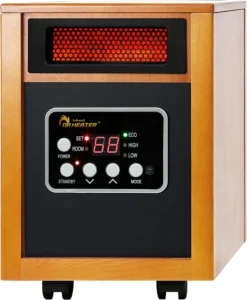
1. Dr Infrared Heater DR-968 — Best Overall
The Dr Infrared Heater DR-968 is one of the most established choices in the portable infrared-heater category.
It combines an infrared quartz heating element with PTC heating rather than relying solely on radiant heating.
Its published specifications include 1,500 watts, a 120-volt electrical supply, two heat settings, electronic temperature control, remote operation and a 12-hour automatic shutoff timer. Documentation also identifies tip-over and overheat protection.
Best For
- Large rooms requiring supplemental heat
- Living rooms
- Bedrooms
- Home offices
- Consumers wanting a portable cabinet-style heater
- Shoppers who want remote control
Key Specifications
- Model: DR-968
- Power: 1,500 watts
- Voltage: 120V
- Heating: Infrared quartz + PTC
- Heat settings: Two
- Thermostat: Electronic
- Temperature range: 50–85°F
- Timer: Up to 12 hours
- Remote: Yes
- Tip-over protection: Yes
- Overheat protection: Yes
- Cord: Approximately 6 feet
- Weight: Published sources vary by listing; check current listing/manual
The manufacturer’s/manual information identifies the DR-968’s dual heating system, thermal protection, tip-over switch, LED display and remote control.
Heating Performance
The combination of infrared quartz and PTC heating makes the DR-968 more versatile than a simple radiant element.
It can provide noticeable warmth in the area around the heater while the blower helps distribute heated air. This makes it a sensible option for larger occupied rooms when used as supplemental heating.
However, “large room” should not be interpreted as “whole-house heating.” Room insulation, ceiling height, drafts and outdoor temperature all influence real-world performance.
Energy Use
At its maximum 1,500-watt setting, the heater consumes approximately 1.5 kWh for every hour of continuous operation.
Actual consumption can be lower when thermostat cycling reduces the amount of time the heating element operates.
Noise
Published information describes the blower as relatively quiet, with approximately 39 dB cited for the model. Actual perceived noise can vary depending on the room and operating conditions.
Pros
- Dual infrared + PTC heating system
- 1,500-watt output
- Electronic thermostat
- Remote control
- 12-hour timer
- Tip-over and overheat protection
- Portable cabinet design
Cons
- Larger and heavier than compact personal heaters
- Uses substantial electricity at full power
- Better suited to supplemental rather than whole-home heating
Who Should Buy It?
The DR-968 is a strong choice for someone looking for a best infrared heater for home use where portability, thermostat control and supplemental heating matter.
Who Should Avoid It?
Avoid it if you want a tiny personal heater that can sit on a desk or if you specifically need a permanently mounted heater.

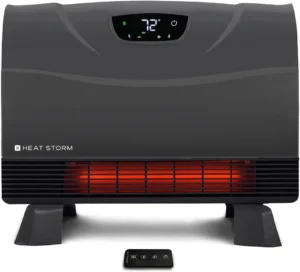
2. Heat Storm Phoenix HS-1500-PHX — Best for Bedrooms and Offices
The Heat Storm Phoenix HS-1500-PHX offers a different approach to infrared heating.
Instead of using the traditional portable cabinet-style design, the Phoenix can sit on the floor with its attachable feet or be mounted directly on a wall.
The model features 750- and 1,500-watt heat settings, along with a convenient remote control for adjusting the temperature from a distance.
Best For
- Bedrooms
- Home offices
- Apartments
- Smaller living areas
- People who prefer wall-mounted heating
- Consumers who want to keep floor space available
Key Specifications
- Model: HS-1500-PHX
- Maximum power: 1,500W
- Lower setting: 750W
- Configuration: Wall or floor
- Remote: Yes
- Thermostatic control: Yes
- Heating technology: Infrared
- Feet: Included for floor configuration
Heating Performance
The Phoenix is especially attractive when you want supplemental heat without dedicating a large amount of floor space to a cabinet heater.
For a home office, for example, wall mounting can keep the heater out of the way while allowing heat to be directed into the occupied area.
Energy Use
At 1,500 watts, continuous operation uses about 1.5 kWh per hour. At 750 watts, consumption is approximately 0.75 kWh per hour. The lower setting can therefore be useful when maximum output is unnecessary.
Pros
- Wall or floor installation
- Two power levels
- Remote control
- Compact wall-oriented design
- Suitable for offices and bedrooms
- Useful when floor space is limited
Cons
- Wall mounting requires appropriate installation
- Not a replacement for central heating
- Current price and availability fluctuate
Who Should Buy It?
This is a good candidate for shoppers looking for the best infrared heater for bedroom or home office where a less intrusive heater is desirable.
Who Should Avoid It?
Choose another model if portability between multiple rooms is your primary requirement.
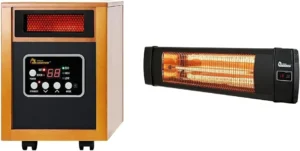
3. Dr Infrared Heater DR-238 — Best Mounted Directional Infrared Heater
The DR-238 is designed for a different job from the DR-968. It is a carbon infrared heater intended for indoor and outdoor applications and can be mounted to a wall or ceiling.
Published specifications identify three power levels—900W, 1,200W and 1,500W—and a 120-volt connection.
Best For
- Garages
- Workshops
- Covered patios
- Directional heating
- Wall-mounted applications
- Areas where floor space is limited
Heating Performance
Unlike a conventional fan heater that primarily distributes warm air, the DR-238 is designed to provide directional radiant heat.
That makes it particularly useful when the objective is to warm people or an occupied zone rather than evenly heat an entire enclosed room.
Key Specifications
- Model: DR-238
- Maximum power: 1,500W
- Power levels: 900W / 1,200W / 1,500W
- Voltage: 120V
- Technology: Carbon infrared
- Installation: Wall/ceiling
- Remote: Yes
- Weather resistance: Published as IP55
Pros
- Directional radiant heat
- Three power levels
- Wall/ceiling mounting
- Useful for garages and covered outdoor areas
- Doesn’t consume floor space
- Remote control
Cons
- Not as portable as a cabinet heater
- Directional heating is less suitable for uniform whole-room heating
- Installation needs appropriate mounting
Who Should Buy It?
It is a strong candidate for someone searching for the best infrared heater for garage or a workshop where targeted radiant heat is more useful than a portable fan heater.
Who Should Avoid It?
It may not be the right choice for someone who wants a portable heater that can be carried from bedroom to office.
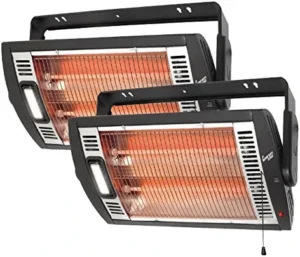
4. Comfort Zone CZQTV5M — Best Ceiling-Mounted Workshop Option
The Comfort Zone CZQTV5M is designed as a ceiling-mounted radiant heater, offering a different setup from traditional portable space heaters.
It uses a 1,500-watt dual-quartz heating system with two heat settings of 750 and 1,500 watts. The heater also features an adjustable tilt and a built-in halogen work light, making it practical for garages, workshops, and other work areas.
Best For
- Garages
- Workshops
- Storage areas
- Workspaces where floor space is limited
Key Features
- Dual quartz infrared elements
- 750W and 1,500W settings
- Ceiling-mounted configuration
- Adjustable tilt
- Built-in work light
- Overheat protection
Heating Performance
The ceiling position makes this heater particularly useful in areas where floor-mounted heating equipment could interfere with vehicles, tools or work areas. Its radiant approach is also useful for heating an occupied zone directly.
Pros
- Saves floor space
- Two heating levels
- Adjustable direction
- Built-in light
- Appropriate for workshop environments
Cons
- Installation is less convenient than a portable heater
- Not designed primarily as a bedroom heater
Who Should Buy It?
Consider it if you want a garage infrared heater that stays off the floor.
Who Should Avoid It?
It is unnecessary for shoppers who simply want to move a heater between rooms.
5. LifeSmart KUH25-01 — Portable Quartz Infrared Alternative
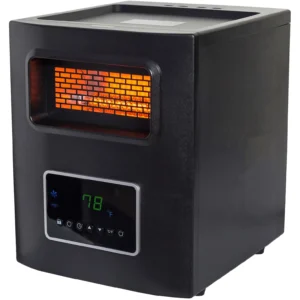
The LifeSmart KUH25-01 is another portable infrared design documented with quartz infrared heating, 1,500 watts of maximum power, thermostat control, temperature adjustment, timer, remote control, display, three heating modes, tip-over protection and overheat protection.
Best For
- General supplemental heating
- Bedrooms
- Living rooms
- Home offices
- Portable use
Key Specifications
- Model: KUH25-01
- Maximum power: 1,500W
- Technology: Quartz infrared
- Heat modes: Three
- Thermostat: Yes
- Timer: Yes
- Remote: Yes
- Display: Yes
- Tip-over protection: Yes
- Overheat protection: Yes
Pros
- Portable design
- Quartz infrared heating
- Multiple heating modes
- Thermostat
- Remote control
- Timer
- Safety protection
Cons
- Availability can fluctuate
- Less compelling if you specifically need wall mounting
- Current price should be checked before purchase
How We Evaluated These Heaters
This is a consumer-focused comparison, not a laboratory test and not a Consumer Reports ranking. We evaluated the heaters using criteria that matter when choosing supplemental electric heating equipment:
Heating Performance
We considered the heating technology, power output and intended application.
Temperature Control
A useful thermostat can prevent the heater from continuously operating at maximum power when the desired temperature has already been reached.
Safety
We looked for published features such as overheat protection, tip-over protection and automatic shutoff where applicable.
Convenience
Remote controls, timers, displays and multiple heat settings can make everyday operation easier.
Portability
Portable cabinet heaters can be moved between rooms, while wall- and ceiling-mounted models are better suited to dedicated locations.
Energy Consumption
We considered electrical wattage without making unsupported claims that infrared heating is universally cheaper than every other heating system.
Build Quality
Brand reputation, construction information and available product documentation were considered.
What Is an Infrared Heater?
An infrared heater produces radiant energy that transfers heat to objects and people in its effective range.
Think about standing outside in sunlight on a cool day. The surrounding air can remain chilly, but sunlight can still make your skin feel warmer.
Infrared heaters use a similar basic concept of radiant heat.
Traditional fan-forced heaters primarily heat air and then circulate that air around the room. Infrared heaters can provide a more direct warming sensation because radiant energy can reach nearby surfaces and occupants.
Many modern electric heaters combine technologies. For example, the DR-968 combines infrared quartz and PTC heating.
Infrared heating should therefore not be interpreted as a magical alternative to electricity consumption. A 1,500-watt infrared heater still uses electrical power.
The main advantage is how the heat is delivered and where it can be useful, particularly for supplemental heating.
Infrared vs. Conventional Space Heaters
| Feature | Infrared Heater | Conventional Fan Heater |
|---|---|---|
| Heating method | Radiant and/or combined heating | Heated air |
| Heat distribution | Direct + room warming | Air circulation |
| Air movement | Often low or moderate | Usually noticeable |
| Fan noise | Depends on model | Usually present |
| Warm-up experience | Direct radiant warmth | Warm air |
| Portability | Many portable models | Many portable models |
| Best use | Supplemental/targeted heating | General room heating |
Neither technology is automatically better for every home.
A bedroom user who dislikes moving air may prefer radiant heating. Someone who wants rapid air circulation throughout a room may prefer a fan-forced design.
Infrared vs. Ceramic Heaters
Infrared and ceramic heaters are often compared because both are common electric space-heating technologies.
Infrared
Infrared heating emphasizes radiant energy and can warm objects and people directly.
Ceramic
Ceramic space heaters typically use a ceramic heating element, frequently combined with a fan that moves warm air around the room.
Fan-Forced
Fan-forced models prioritize heating and circulating air.
Oil-Filled Radiators
Oil-filled radiators heat an internal fluid and transfer heat to surrounding air. They generally provide quiet operation but respond differently from fan heaters.
| Factor | Infrared | Ceramic | Oil-Filled |
|---|---|---|---|
| Main heat transfer | Radiant | Heated air | Radiator surface + air |
| Fan | Model dependent | Common | No |
| Noise | Often low | Fan noise | Very quiet |
| Direct heat feel | Strong | Moderate | Moderate |
| Portability | Often good | Often excellent | Moderate |
| Best use | Targeted/supplemental | General room heating | Quiet sustained heating |
Complete Infrared Heater Buying Guide
1. Room Size
Start with the room rather than wattage. A small bedroom does not necessarily need the same heater configuration as a large living room or garage.
2. Wattage
Most household portable electric heaters operate around 1,500 watts at maximum output.
At 1,500W:
1.5 kW × hours used = kWh consumed
Wattage tells you electrical demand; it does not automatically tell you how comfortable the room will feel.
3. Heating Technology
Look for whether the heater uses quartz infrared, carbon infrared or a combination of infrared and another heating technology.
4. Thermostat
A thermostat can automatically cycle heating according to the selected temperature.
5. Heat Settings
Multiple settings provide more control than a basic on/off heater.
6. Temperature Control
Digital controls can be useful when precise temperature adjustment is important.
7. Remote Control
A remote is particularly convenient for bedrooms and offices.
8. Timer
A timer can help prevent unnecessarily long operation.
9. Oscillation
Oscillation can help distribute heat over a wider area in applicable portable models.
Also Read: Top 10 Consumers Report Best Air Fryer For Every Kitchen With Complete Buying Guide
10. Portability
Casters, handles and compact dimensions matter if you plan to move the heater.
11. Noise
If using the heater in a bedroom or office, consider whether the model uses a fan.
12. Safety Features
Look for documented overheat protection, tip-over protection and automatic shutoff where applicable.
13. Electrical Certification
Look for recognized safety certification information when provided by the manufacturer or listing.
14. Build Quality
A heater used regularly during winter should have solid construction and dependable controls.
15. Cord Length
A longer cord can provide more installation flexibility, but the heater should still be connected according to the manufacturer’s electrical instructions.
16. Display
A digital display can make temperature settings easier to see.
17. Ease of Cleaning
Dust can accumulate around air intakes and vents, particularly on fan-assisted heaters.
18. Warranty
Warranty coverage can be important when comparing similar-priced heaters.
19. Price
Don’t automatically select the cheapest heater. Consider controls, safety features, construction and intended use.
20. Long-Term Operating Cost
Operating cost depends on:
- Wattage
- Runtime
- Thermostat cycling
- Electricity rates
- Insulation
- Outdoor temperature
- Desired indoor temperature
Best Infrared Heaters by Room
Best Infrared Heater for Bedroom
Our pick: Heat Storm Phoenix HS-1500-PHX
Its wall/floor configuration can be particularly convenient in bedrooms where floor space is limited. Look for a thermostat, timer and appropriate safety features.
Limitation: It should be used according to manufacturer instructions and should not be treated as a substitute for a home’s primary heating system.
Best Infrared Heater for Large Room
Our pick: Dr Infrared Heater DR-968
Its 1,500-watt output and combination infrared/ PTC heating system make it a strong supplemental-heating candidate.
However, large-room performance depends heavily on insulation, ceiling height, drafts and outdoor conditions.
Best Infrared Heater for Small Room
A compact heater can be preferable when the objective is personal or localized warmth.
The important considerations are controllability, safety, size and electrical requirements—not simply maximum wattage.
Best Infrared Heater for Living Room
Our pick: Dr Infrared Heater DR-968
Its portable cabinet design makes it easier to position near the occupied area.
Best Infrared Heater for Home Office
Our pick: Heat Storm Phoenix
Wall mounting can keep valuable floor space available around a desk.
Best Infrared Heater for Garage
Our pick: Dr Infrared Heater DR-238
Its directional carbon infrared design and mounting configuration make it more appropriate for garage or workshop applications than a traditional bedroom heater.
Published information identifies it for garage and outdoor applications.
Best Infrared Heater for Apartment
Our pick: Dr Infrared Heater DR-968
For renters, portability is valuable because a heater can potentially be moved between rooms without permanent installation.
Always follow building rules and manufacturer instructions.
Electricity Cost and Energy Use
One of the biggest misconceptions about infrared heaters is that “infrared” automatically means very low electricity consumption.
It doesn’t.
Suppose you operate a 1,500-watt heater continuously.
1,500 watts = 1.5 kilowatts
If it runs for four hours:
1.5 kW × 4 hours = 6 kWh
Now assume, purely as an example, an electricity rate of $0.18 per kWh:
6 kWh × $0.18 = $1.08
So four hours of continuous full-power operation would cost approximately $1.08 under this hypothetical rate.
Actual costs vary substantially across the United States.
Thermostat cycling can also reduce the amount of time the heating element operates at full power.
That is why the best energy efficient infrared heater is not necessarily the heater with the lowest advertised wattage. A more useful question is:
How much power does the heater use, and how long will I actually need to operate it?
Infrared Heater Safety Guide
Electric space heaters should always be treated as high-temperature electrical appliances.
Keep Clear Space Around the Heater
Keep curtains, bedding, clothing, furniture and other combustible materials away from the heater.
Use a Stable Surface
Portable heaters should be positioned on a stable surface where they cannot easily tip over.
Never Cover the Heater
Blocking vents or covering the heater can interfere with normal operation and create a safety hazard.
Inspect the Cord
Do not use a heater with a damaged plug or power cord.
Be Careful With Extension Cords
Do not use an extension cord unless the manufacturer specifically permits the configuration and the electrical requirements are satisfied.
Use an Appropriate Wall Outlet
Follow the manufacturer’s instructions for electrical connection.
Keep Away From Water
Unless a model is specifically designed and rated for the intended environment, keep it away from water and excessive moisture.
Keep Children and Pets Away
The exterior and heating elements can become hot during operation.
Don’t Leave It Running Unattended
Turn the heater off when leaving the room unless the manufacturer’s instructions specifically address the intended operating condition.
Follow the Manual
The product manual should always take priority over generic advice.
Look for Recognized Certification
Where applicable, recognized electrical safety certification can provide additional assurance that the product has been evaluated against relevant standards.
Infrared Heater Maintenance Tips
Proper maintenance can help keep an electric heater operating as intended.
Clean Dust
Dust can accumulate around air intakes and vents.
Keep Vents Unblocked
Never obstruct the heater’s air openings.
Inspect the Cord
Look for signs of wear before each heating season.
Store Properly
When winter ends, store the heater in a clean, dry location according to manufacturer instructions.
Inspect Before Seasonal Use
Before switching a heater on after months of storage, inspect the housing, plug and cord.
Don’t Repair Electrical Components Yourself
Do not open the heater or attempt internal electrical repairs unless you are appropriately qualified and the manufacturer explicitly supports the procedure.
Infrared Heater Common Buying Mistakes
Buying Based Only on Wattage
Higher wattage doesn’t automatically mean better heating for your particular room.
Assuming Infrared Means Zero Energy Consumption
Infrared electric heaters still consume electricity.
Assuming One Heater Can Heat an Entire House
Portable heaters are generally supplemental appliances.
Ignoring Room Conditions
Drafty windows, poor insulation and high ceilings can dramatically affect comfort.
Ignoring Safety Features
Safety should be part of the buying decision.
Ignoring Electrical Requirements
A 1,500-watt appliance places a significant load on a household circuit.
Choosing a Heater Without a Thermostat
A thermostat can make temperature management much more convenient.
Buying Solely on Amazon Stars
Ratings are useful, but they should be evaluated alongside specifications, product design and intended application.
Ignoring Warranty Information
A lower upfront price isn’t necessarily better long term.
Using an Unsuitable Extension Cord
This can create unnecessary electrical risk.
Ignoring Manufacturer Instructions
Always read the operating and safety instructions before use.
Frequently Asked Questions about Best Infrared Heater
Q. What is the best infrared heater?
Ans. For a portable supplemental-heating application, the Dr Infrared Heater DR-968 is our overall editorial pick because of its 1,500-watt output, dual infrared/PTC heating system, thermostat, remote and safety features.
Q. Are infrared heaters worth it?
Ans. They can be worthwhile when you need supplemental heat in a specific occupied room or area.
They are less appropriate when you expect one portable heater to replace an entire home’s central heating system.
Q. Are infrared heaters energy efficient?
Ans. Infrared heaters can be efficient at converting electrical energy into heat, but that does not mean they will always cost less to operate than every other heating system. Operating cost depends on wattage, runtime and electricity rates.
Q. Do infrared heaters use a lot of electricity?
Ans. A 1,500-watt heater operating continuously uses approximately 1.5 kWh per hour. Your actual consumption can be lower if the thermostat cycles the heating element.
Q. Can an infrared heater heat a large room?
Ans. Some are designed for larger-room supplemental heating, but actual performance depends on insulation, room size, ceiling height, drafts and outdoor temperature.
Q. Are infrared heaters safe?
Ans. Electric infrared heaters can be used safely when designed with appropriate safety features and operated correctly.
However, no portable heater should be described as “100% safe.” Follow the manufacturer’s safety instructions.
Q. What is the difference between infrared and ceramic heaters?
Ans. Infrared heaters emphasize radiant heat, while ceramic heaters commonly heat air through a ceramic element and fan. Some modern heaters combine multiple technologies.
Q. What is the best infrared heater for a bedroom?
Ans. The Heat Storm Phoenix HS-1500-PHX is a strong choice for a bedroom where wall mounting and thermostat control are useful.
Q. What is the best infrared heater for a garage?
Ans. The Dr Infrared Heater DR-238 is particularly suitable for directional heating applications such as garages and workshops because of its carbon infrared design and mounting options.
Q. Do infrared heaters dry out the air?
Ans. Infrared heating itself does not remove moisture from the air in the same way that some combustion heating processes can affect indoor air.
However, perceived dryness during winter is often related to lower outdoor humidity and indoor heating conditions generally.
Q. How long do infrared heaters last?
Ans. Lifespan varies according to construction, heating element, operating frequency, maintenance and use. There is no single lifespan that applies to every infrared heater.
Q. Can I leave an infrared heater running overnight?
Ans. Only follow the manufacturer’s specific operating instructions. Because portable electric heaters can present fire and electrical hazards, users should not assume that overnight operation is appropriate simply because a heater has a timer or thermostat.
Final Verdict on Best Infrared Heater Consumer Report
There isn’t one infrared heater that is perfect for every American household. The best choice depends on where you want to use it and how you want to use it.
🏆 Best Overall: Dr Infrared Heater DR-968
Why: Strong combination of 1,500-watt output, infrared + PTC heating, electronic thermostat, remote control, timer and safety features.
💰 Best Value: Heat Storm Phoenix HS-1500-PHX
Why: Its 750/1,500-watt configuration and wall/floor flexibility make it useful for bedrooms, offices and apartments.
⭐ Best Mounted Option: Dr Infrared Heater DR-238
Why: Directional carbon infrared heating and wall/ceiling mounting make it particularly useful for garages, workshops and covered outdoor spaces.
🛏 Best for Bedrooms: Heat Storm Phoenix
Why: Its wall-mount capability can save floor space while providing adjustable supplemental heat.
🏡 Best for Large Rooms: Dr Infrared Heater DR-968
Why: The combination of infrared quartz and PTC heating makes it one of the more versatile portable choices in this comparison.
🔥 Best for Supplemental Heating: Dr Infrared Heater DR-968
Why: It combines useful controls with a portable cabinet design.
🚗 Best for Garages: Dr Infrared Heater DR-238
Why: Its directional radiant-heating design is better aligned with garage/workshop applications than a conventional bedroom-oriented portable heater.
💼 Best for Home Offices: Heat Storm Phoenix
Why: Wall mounting can preserve desk and floor space.
🪶 Best Portable: Dr Infrared Heater DR-968
Why: Its cabinet-style portable design and caster-based mobility make it easy to reposition.
⚡ Best Energy-Conscious Approach
Rather than selecting a heater solely because it is advertised as “energy efficient,” choose the appropriate wattage and use a thermostat-controlled model so you aren’t unnecessarily operating at maximum output.
| Product | Type | Wattage | Heating Technology | Thermostat | Remote | Timer | Pricing |
|---|---|---|---|---|---|---|---|
| Dr Infrared Heater DR-968 | Portable cabinet | 1,500W | Infrared quartz + PTC | Yes | Yes | 12-hour | Check Price on Amazon |
| Heat Storm Phoenix HS-1500-PHX | Wall/floor | 750/1,500W | Infrared | Yes | Yes | Yes | Check Price on Amazon |
| Dr Infrared Heater DR-238 | Mounted | Up to 1,500W | Carbon infrared | Not treated as equivalent to DR-968 | Yes | Check listing | Check Price on Amazon |
| Comfort Zone CZQTV5M | Ceiling-mounted | 750/1,500W | Dual quartz infrared | Check listing | No remote emphasized | Check listing | Check Price on Amazon |
| LifeSmart KUH25-01 | Portable cabinet | 1,500W | Quartz infrared | Yes | Yes | Yes | Check Price on Amazon |